Few genre labels are argued about as passionately as this one. Ask ten players what is a soulslike and you may get ten different answers. This analysis traces the label back to its origins, identifies the core traits most people agree on, and then examines where the definition breaks down, from 2D platformers and action RPGs to games that borrow only a single mechanic and still get the soulslike tag.
Key Takeaways
- What is a soulslike? A game inspired by FromSoftware's Souls series, built on challenging combat and learning through failure
- Common traits include stamina-based combat, checkpoint resting points, and lost currency on death
- The label has expanded so widely that it can become meaningless
- Soulsborne refers specifically to FromSoftware's own Souls games and Bloodborne
Where the Term Comes From
The genre is named after Dark Souls, released by FromSoftware in 2011, but its formula began with Demon's Souls on PS3 in 2009. Their success led other developers to borrow key ideas, and players began calling those games soulslikes. Later FromSoftware titles, including Bloodborne in 2015, Sekiro: Shadows Die Twice in 2019, and Elden Ring in 2022, expanded the template while keeping its core identity.
The Core Traits
1. Deliberate, stamina-based combat where every attack and dodge has a cost
2. Resting points such as bonfires that refill healing but respawn enemies
3. Dropping currency or experience on death, with one chance to recover it
4. Challenging bosses that require learning attack patterns
5. Interconnected worlds with shortcuts that unlock as you progress
6. Minimal handholding and story told through items and environments
Most games that meet four or more of these are widely accepted as soulslikes, which is a practical way to answer what is a soulslike without endless debate.
Soulslike Versus Soulsborne
Soulsborne is a narrower term combining Souls and Bloodborne. It usually refers only to FromSoftware's own games in that lineage, while soulslike covers games from any developer inspired by them. Using soulsborne for third-party games is a common mix-up, and fans often correct it.
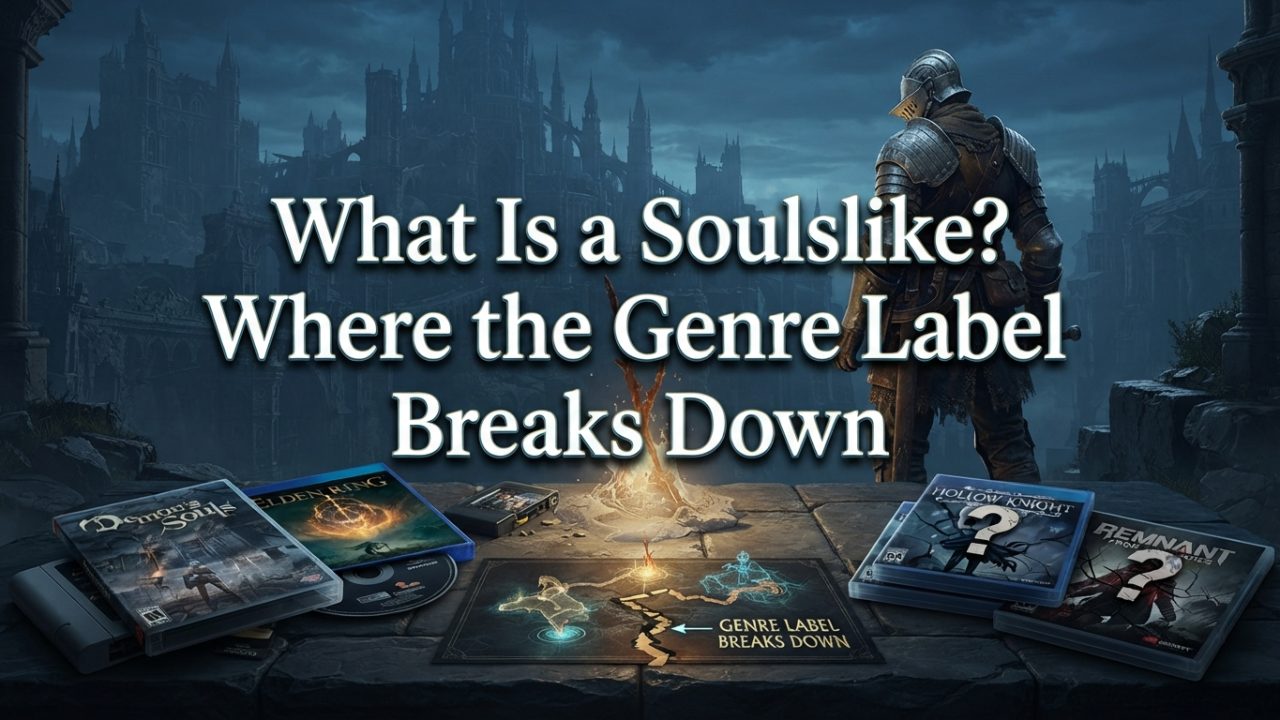
What Is a Soulslike? Where the Label Breaks Down
As the genre grew, the label stretched. 2D games like Hollow Knight share difficulty, exploration, and lost currency, so some call them soulslikes, while others prefer the Metroidvania label. Action games with tough bosses but no stamina system are sometimes tagged soulslike simply for being hard. Games like Black Myth: Wukong spark debate because they borrow combat ideas while differing in structure. When nearly any challenging game earns the tag, the question of what is a soulslike loses its usefulness.
Difficulty Is Not the Whole Story
A common misconception is that soulslike just means very hard. Difficulty matters, but what defines the genre is how it teaches through failure: dying reveals patterns, and returning with that knowledge feels rewarding. A game that is hard because of unfair design or poor controls misses that loop entirely, even if it carries the label in marketing.
Games That Blur the Lines
- Hollow Knight — 2D exploration with soulslike death mechanics
- Nioh — fast combat with loot systems inspired by action RPGs
- Lies of P — closely follows the Souls template with its own parry system
- Elden Ring Nightreign — a co-op roguelike spin-off that bends FromSoftware's own formula
These examples show the genre is a spectrum rather than a strict box, and that understanding what is a soulslike works best as a set of shared ideas rather than a checklist.
Why the Label Still Matters
Despite the debates, the label remains useful for players. It signals a certain style of challenge, pacing, and reward, helping people find games they will enjoy and avoid ones that may frustrate them. Developers use it to reach an audience that actively seeks demanding combat and atmospheric worlds.
The Role of Online Features
FromSoftware's games also introduced asynchronous online features, such as player messages left on the ground, bloodstains showing how others died, and the ability to summon helpers or invade other worlds. Many soulslikes copy some of these, while others skip them entirely. These features are not essential to the genre, but they contribute to the shared, mysterious atmosphere that many players associate with the answer to what is a soulslike.
Why Developers Embrace the Label
For smaller studios, the soulslike tag is a powerful marketing tool because it signals a clear experience to an enthusiastic audience. Games such as Lies of P and Lords of the Fallen leaned into the label and found success. The risk is that overusing it can disappoint players when a game borrows only surface elements without the careful design that made the originals work.
How to Tell if You Will Enjoy a Soulslike
- You enjoy learning patterns through repetition
- You like piecing together stories from item descriptions
- You find satisfaction in overcoming difficult challenges
- You can tolerate losing progress occasionally
If most of these describe you, the genre is likely a great fit. If not, accessible entries with flexible difficulty options may be a better starting point.
For newcomers who are still unsure what is a soulslike experience feels like, watching a few minutes of gameplay from different titles is a helpful first step. Notice how players approach bosses, manage stamina, and recover from death. Comparing several games side by side reveals the shared DNA far more clearly than any written definition, and it helps you find the entry point that matches your taste and patience.
Ultimately, debates about what is a soulslike say as much about the community as the games. Players care deeply about the design ideas that made these titles special, and arguing over labels is a way of protecting those ideas. As long as new games keep experimenting with the formula, the conversation will continue, and that ongoing debate about what is a soulslike is a sign of a genre that is still very much alive.
In short, what is a soulslike? A game inspired by FromSoftware's Souls series, defined by deliberate combat, resting points, lost currency on death, and learning through failure, rather than difficulty alone. The label stretches and sometimes breaks, but as a spectrum it still helps players find the experiences they want. Which game do you think best fits the definition?