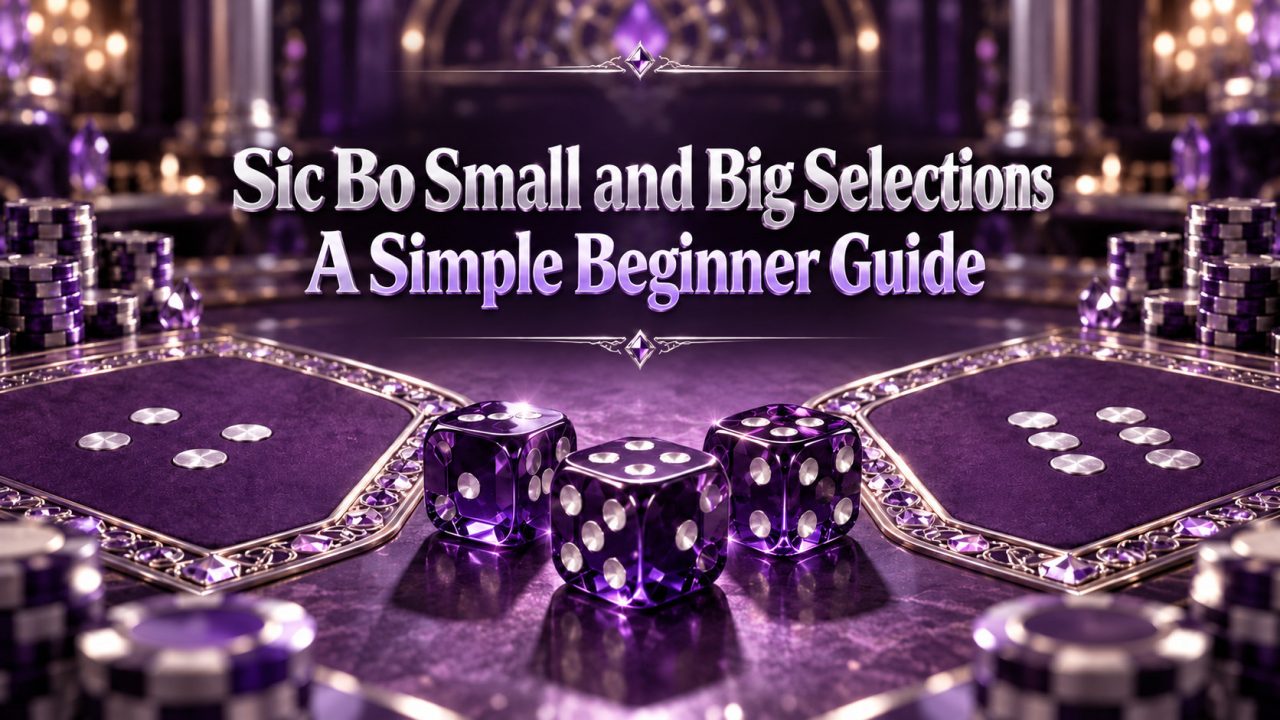
Sic Bo Small and Big Selections are the most popular positions on the Sic Bo table, since they carry the lowest house edge compared to every other position available. This guide explains the rules and the house edge figure behind these selections in the simplest terms. It's also the starting point most experienced players recommend to newcomers by word of mouth.
Key Takeaways
- Sic Bo Small and Big Selections cover the total of all three dice.
- Small wins when the total falls between 4 and 10, while Big wins when the total falls between 11 and 17.
- Both selections pay at equal payout, 1 to 1.
- If a triple appears (all three dice matching), both Small and Big lose immediately.
- The probability of winning on Small or Big sits at roughly 48.61%, giving a house edge of about 2.78%
- Even though Small and Big carry a low house edge, no strategy guarantees a profit, since each round is an independent event unrelated to the one before it
- Compared to other positions on the Sic Bo table, Small and Big offer the best balance between being easy to understand and carrying the lowest house edge
- If a player selects Small with one unit repeatedly across 100 rounds, the average expected loss comes out to roughly 2.78 units from a total of 100 units placed
What Does the Small Selection Cover
Small wins whenever the total of all three dice falls between 4 and 10, paying at equal payout at 1 to 1. It's one of the most popular selections on the Sic Bo table, since it's easy to understand and carries fairly strong odds of winning compared to other selections. Many players choose this selection first every time they sit down, since there's no specific total to memorize and the range itself is easy to track visually.
What Does the Big Selection Cover
Big wins whenever the total of all three dice falls between 11 and 17, paying at equal payout at 1 to 1, just like Small. Both of these selections are frequently chosen by beginners looking for simplicity and rules that are quick to pick up. Some tables even allow placing chips on both Small and Big within the same round, depending on that casino's own house rules.
Why Does a Triple Make Both Small and Big Lose
An important rule to know is that if all three dice land on the same number, known as a triple, both the Small and Big selections lose immediately regardless of the total. This exact rule is what creates the house edge on selections that otherwise look like they carry strong odds. Without this triple rule, the odds of winning on Small or Big would sit at exactly 50%, leaving the casino with no mathematical edge at all.
What Is the House Edge on Small and Big
The probability of winning on Small or Big sits at roughly 48.61%, giving a house edge of about 2.78%. This is the lowest house edge among every selection available on the Sic Bo table, making it well-suited to players seeking the best possible expected return. That figure runs noticeably lower than many other casino games, which commonly carry a house edge above 5% by comparison.
Why Small and Big Suit Beginners Best
Small and Big suit beginners best because there's no complex payout table to memorize like with other selections — simply understanding which range the total falls into is enough. The lowest house edge on the list also makes this a safer starting point for anyone getting familiar with Sic Bo for the first time. Newcomers are often advised to study the game's pace from this selection before trying anything more complex.
Strategies Worth Knowing for Small and Big
Even though Small and Big carry a low house edge, no strategy guarantees a profit, since each round is an independent event unrelated to the one before it. Some players choose their selection based on recent results, such as switching to Big after Small has appeared several rounds in a row, but this approach has no mathematical backing that it actually improves the odds of winning. Players who understand probability tend to avoid chasing streaks like this, since past results carry no weight on the next round.
What to Watch For When Selecting Small and Big Often
Even though Small and Big carry the lowest house edge on the table, that figure still favors the house every single time. Repeating the same selection with the same stake across many rounds still tends toward an accumulated loss over the long run, statistically speaking. Players should always set a budget for each session in advance to keep risk under control, and capping the number of rounds played per session is another useful way to limit accumulated risk.
Comparing Small and Big to Other Table Positions
Compared to other positions on the Sic Bo table, Small and Big offer the best balance between being easy to understand and carrying the lowest house edge. A position like a specific triple, despite paying as high as 150 to 180 times the stake, carries a house edge roughly six times higher. This comparison makes it clear why Small and Big are the recommended starting point for everyone, especially anyone still unfamiliar with the rest of the table.
A Real Example of Expected Return
If a player selects Small with one unit repeatedly across 100 rounds, the average expected loss comes out to roughly 2.78 units from a total of 100 units placed. This figure runs clearly lower than every other position on the Sic Bo table, and it's the main reason Small and Big remain the most popular choice among players of every experience level. The list below compares this figure against two other popular selections:
- Small/Big: 100 (2.78)
- Single Number: 100 (3.7-7.87)
- Specific Triple: 100 (16.2)
Frequently Asked Questions About Small and Big
Many people wonder why not simply select both Small and Big in the same round. The answer is that this is possible, but the combined house edge stays exactly the same, since the two positions have no mathematical relationship to each other. Another common question is how often a triple actually occurs, and the answer is roughly 2.78% per round, a fairly rare outcome compared to the rest of the possibilities.
Is Small and Big Different Online Compared to a Real Table
Small and Big work exactly the same whether played at a real table or on an online platform, since the rules and payouts follow the same standard. The only real difference is the pace of each round, since online tables usually run on a fast automatic randomization system rather than waiting for a dealer to shake by hand, letting online players get through more rounds in the same amount of time.
How Experienced Players View This Position
Experienced players often see Small and Big as the foundational position everyone should understand before moving on to anything else, since even the lowest house edge on the table still favors the casino over the long run. Experienced players tend to use this position as a starting point for understanding the overall table, rather than viewing it as a guaranteed way to turn a profit over time and time again.
Sic Bo Small and Big Selections in a Nutshell
In short, Sic Bo Small and Big Selections cover the total of the dice, paying at equal payout at 1 to 1, but losing immediately whenever a triple appears. That rule gives them a house edge of roughly 2.78%, the lowest figure anywhere on the Sic Bo table, which is exactly why so many players treat this pairing as the natural starting point before exploring riskier positions elsewhere on the layout.